Jobber pricing in 2026, and what it actually costs once you add your crew

The short version
- If you are on your own
- Jobber — Core at $29/mo prepaid is the best product for one person, provided you can live without automated follow-ups.
- If you have a crew of two to four
- QuoteIQ — Pro includes four users for $149.99/mo. The equivalent Jobber setup is Grow plus three seats at $286/mo.
- If you are five or more
- Housecall Pro — Essentials includes five seats at $189/mo, which beats Jobber the moment your headcount does.
Jobber’s advertised price is $29 a month. That number is one user, prepaid for a year, on the tier that does not do quote follow-ups. It is a real price, and it is not the price most people reading this will pay.
Here is what the plans actually cost, what the seat charge does to the total, and where the maths stops working in Jobber’s favour.
Every Jobber plan, current pricing
| Plan | Monthly | Paid annually | Users | Extra user | What it adds |
|---|---|---|---|---|---|
| Core | $49/mo | $29/mo | 1 | $29/mo | Quotes, invoicing, online booking, reporting, 100+ integrations |
| Connect | $139/mo | $99/mo | 1 | $29/mo | Adds automated reminders, quote follow-ups, QuickBooks sync, time tracking |
| Grow | $199/mo | $149/mo | 1 | $29/mo | Adds job costing, two-way SMS, upsell line items, custom automations |
| Plus | $499/mo | $399/mo | 5 | $29/mo | Adds Pipeline lead tracking, Marketing Suite, AI Receptionist, dedicated onboarding |
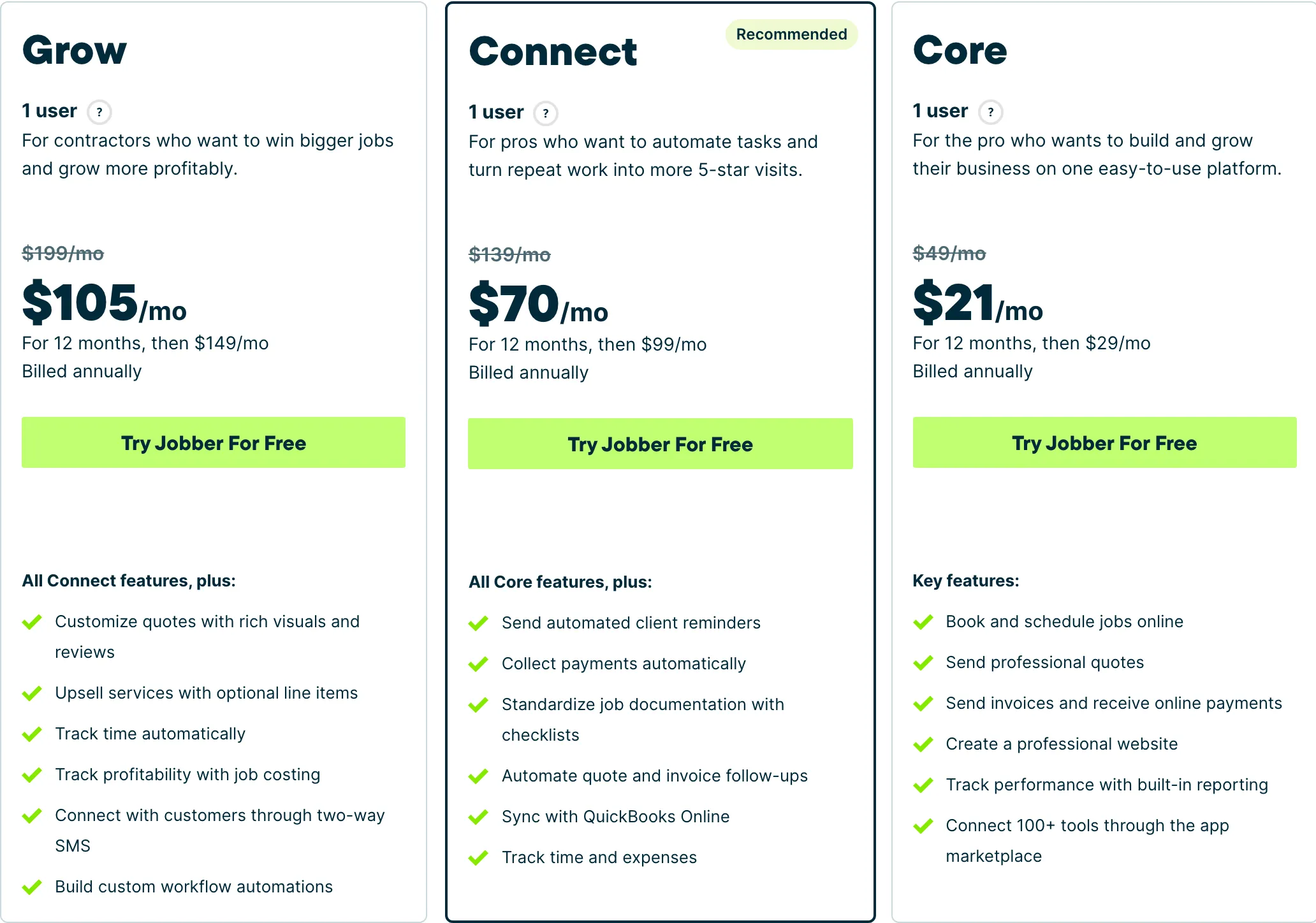
Jobber headlines an introductory annual rate. On 31 August 2026 the page showed Core at $21/mo, Connect $70 and Grow $105 — each "for 12 months, then" $29, $99 and $149 respectively. The annual column above is the ONGOING rate, because that is what you pay from year two. Year one is cheaper than this table.
Payment processing: 2.9% + 30¢ card, 2.7% + 30¢ Tap to Pay, 1% ACH, +1% for instant payout.
Add-ons on top of the plan price: Marketing Suite$99/mo, AI Receptionist$29/mo, Pipeline$49/mo.
Two things in that table do most of the damage to the advertised number.
The first is the gap between monthly and annual. Jobber quotes $29/mo for Core almost everywhere, but that requires paying twelve months up front. Month to month with no commitment, Core is $49. If you are new and not certain you will still be trading in a year, you are paying the $49.
The second is the seat charge. Every plan below Plus includes exactly one user, and each extra person is $29/mo whether they are a full-time tech or a part-timer who checks the schedule on Saturdays.
The three-person crew maths
This is the calculation the pricing page does not do for you. Monthly billing, one owner and two techs:
| Plan | Base | Two extra seats | Real monthly cost |
|---|---|---|---|
| Core | $49 | $58 | $107 |
| Connect | $139 | $58 | $197 |
| Grow | $199 | $58 | $257 |
| Plus (5 seats included) | $499 | — | $499 |
Now put that next to what the same three people cost elsewhere. QuoteIQ’s Pro plan includes four users at $149.99/mo. Housecall Pro’s Essentials includes five at $189/mo. Against Jobber Grow at $257, both include more people for less money.
Against Jobber Core at $107, neither is cheaper. That is the honest version: if all you need is quoting, scheduling and invoicing, Core with two seats is still competitive, and it is a better-built product than anything at that price.
Where the tier jumps hurt
The problem is not the entry price. It is what sits behind the first upgrade.
Automated quote follow-ups and appointment reminders are Connect features. Those two things — chasing a quote you already sent, and cutting no-shows — are usually the first things an operator wants software to do, because they are the ones that directly recover money. Getting them means going from $49 to $139, a 2.8x jump, before you add a single seat.
Job costing, the feature that tells you which jobs actually made money, is Grow. That is $199 base. For a two-truck operation trying to work out whether the commercial accounts are worth keeping, that is the tier, and it is $257 with the crew on it.
Then there are the add-ons on top of the plan: Marketing Suite at $99/mo, Pipeline at $49/mo, AI Receptionist at $29/mo. A Grow plan with three seats and the Marketing Suite is $356 a month.
What Jobber does better than the alternatives
Writing this straight, because the credibility is the product: Jobber is the best piece of software in this category, and the price reflects something real.
The client experience is a class above everything cheaper. The booking page, the quote a customer opens on their phone, the approval flow, the payment — it all looks like it was built by people who care, and it makes a two-person operation look like a twenty-person one. That matters more than operators expect when they are bidding against a bigger company.
The mobile app is the one crews complain about least. Anyone who has rolled out field software knows that is not a small thing; the tool your techs quietly refuse to use is worth nothing regardless of price.
And with 100+ integrations, it fits whatever you already run the books in. Cheaper tools generally sync with QuickBooks Online and stop there.
| Tool | Starts at | Users included | Best for | Verdict |
|---|---|---|---|---|
| Jobber | $49/mo | 1 | Solo operators who want polish | Best product, seat charge on every tier |
| QuoteIQ | $29.99/mo | 1 | Two to four person exterior crews | Four seats at the price of Jobber Connect |
| Housecall Pro | $79/mo | 1 | Crews of five to eight | Five seats included, worst solo price |
| ServiceTitan | Quote only | Unlimited | Ten trucks and up | Enterprise. Not sold at this size. |
Who should pay it, and who should not
Pay it if you are solo and client-facing polish wins you work. Core prepaid at $29/mo is genuinely good value for one person, and the trial is a real 14 days on the Grow plan with no card.
Pay it if you are already on Connect or Grow and it works. Switching costs real time. A $60/mo saving does not pay for a fortnight of a disrupted schedule.
Look elsewhere if you are two to four people and you need automation. That is where the seat charge and the tier jump compound. Grow with three seats is $257; QuoteIQ’s Pro tier is $149.99 with four users and job costing included, and it has property measurement built into the quote, which matters if you price off square footage.
Look elsewhere if you are five or more. Housecall Pro Essentials includes five seats at $189/mo. Jobber’s equivalent is Plus at $499. Housecall Pro’s own weakness is the solo price — $79/mo for one user is the worst entry point of the three — but it inverts once you have a crew.
And if you are ten trucks with an office manager, ServiceTitan is the honest answer, with the honest caveats: no published pricing, an annual contract and a paid implementation. It is a different category of purchase, and for anyone reading this with fewer than about ten vehicles it is the wrong product at any price.
What switching actually involves
If you decide to move off Jobber, the work is smaller than people fear and larger than the vendors claim.
Your client list exports. Jobber exports clients, properties and invoice history to CSV, and every competitor imports that format. Budget an afternoon.
Your quote templates do not. You will rebuild your line items and pricing in the new tool by hand. For most one-to-four person operations that is twenty to forty items and takes an evening.
Recurring jobs are the real work. If you run maintenance contracts, those schedules rebuild manually in most tools. This is the single reason to switch in your slow season rather than in June.
Keep both running for one billing cycle. Overlapping a month costs you one month of the cheaper subscription and saves you from discovering a missing feature with a customer on the phone. Every competitor here has a 14-day free trial, so run the trial in parallel with live Jobber before you cancel anything.
Questions operators actually ask
How much is Jobber per month?
Jobber Core is $49/mo on no-commitment monthly billing for one user, dropping to $29/mo if you prepay a year. Connect is $139/mo, Grow is $199/mo and Plus is $499/mo. Every tier charges $29/mo for each user beyond the ones included, which is the number that changes the answer for most crews.
Does Jobber charge per user?
Yes. Core, Connect and Grow include one user and Plus includes five. Every additional user is $29/mo on every tier. A three-person crew on Core is $107/mo, not $49.
Is there a free version of Jobber?
No. There is a 14-day free trial on the Grow plan with no card required, and after that it is a paid product. Anyone advertising a free Jobber plan is describing the trial.
What is the cheapest way to use Jobber?
Prepay annually on Core at $29/mo for a single user. The catch is that quote follow-ups and automated reminders are Connect features, and those are the two things most operators actually want automated.
Is Jobber worth it compared to cheaper software?
If you are solo and want the most finished product, yes. If you have two or more people, run the seat maths first — at three users Jobber Core costs more per month than tools that include four seats in the base price.