Pressure washing pricing: what to charge, and the formula behind it

Most pressure washing jobs price between $0.10 and $0.40 a square foot, with a $150 to $250 job minimum that matters more than the rate does. Wood and roofs go higher. Everything else on this page is how you land on the right number inside that range, and how to stop underpricing the jobs that look easy.
The rates, by surface
| Surface | Range | What moves it |
|---|---|---|
| House washing (soft wash) | $0.15 – $0.40 /sq ft | Storeys, access, mildew load |
| Driveway, flat concrete | $0.10 – $0.25 /sq ft | Oil, rust, whether sealing is included |
| Deck, fence, wood | $0.25 – $0.60 /sq ft | Species, condition, whether you are also brightening |
| Roof soft wash | $0.20 – $0.75 /sq ft | Pitch, height, moss depth |
| Hourly | $50 – $150 /hr | Commercial repeat at the bottom, one-off residential at the top |
Two notes before you use these. House washing is measured on wall area, not floor area — roughly the perimeter times the height, which for a typical single-storey home is 1,600 to 2,200 square feet, not the 1,500 on the listing. And these are US national ranges; a dense metro supports the top of them and a rural county does not.
The formula
Everything above comes out of the same calculation:
(Area × your rate) × condition factor + travel and access = your quote, floored at your job minimum.
Worked through on a real job. A 2,000 sq ft single-storey house wash, moderate mildew on the north side, twenty minutes out:
- 2,000 sq ft × $0.18 = $360
- Condition factor 1.25 for the mildew = $450
- Travel and access: $0 — it is inside your normal radius
- Above the $200 minimum, so the quote is $450
That job is about three hours on site for one person. $450 for three hours plus travel is roughly $110 an hour before chemicals and fuel, which is a working number for solo residential.
Now change one variable. Same house, two storeys:
- 2,600 sq ft of wall area × $0.18 = $468
- Condition 1.25 = $585
- Height and access +$100 = $685
The house did not get much bigger. The work did.
Price a pressure washing job
Your numbers, the formula above. Nothing is sent anywhere — this runs in your browser.
$360 base (2,000 square feet × $0)
This is a starting number, not a bid. Walk the property before you send it.
What actually changes the price
Access. A back garden you can reach with a hose is a different job from one where every gallon walks through a side gate. Distance from a water source, no outside tap, gated entry, cars that will not move — each of those is time.
Condition. First clean in eight years is not the same job as an annual maintenance wash, and it is the single biggest thing operators forget to charge for. A property that has never been cleaned takes two to three times the dwell time and more chemical.
Height. Anything above one storey adds equipment, setup and risk.
Season. In spring you are turning work away; in November you are not. Charging your peak rate in your slow month loses jobs, and charging your slow rate in May costs you thousands over a season.
Surface risk. Old mortar, painted wood, cedar shingles, anything that might come off. Price the risk or decline the job — the callback on a damaged surface costs more than the job paid.
The mistakes that underprice a job
Quoting off the listing square footage. The house is 1,500 sq ft of floor. You are washing 2,000+ sq ft of wall. That single error is 25% off your price.
Forgetting the round trip. A 45-minute drive each way is 90 minutes unpaid on a job you priced at three hours. That is a $110/hr job turned into a $73/hr job. Either it is inside your radius at your normal rate, or there is a travel charge.
No job minimum. The small driveway that “may as well” get done fills the slot a $450 house wash needed. Set the minimum, hold it, and offer a bundled price instead of a discount.
Matching the cheapest quote in the area. Someone with no insurance and a consumer machine from a hardware store will always be cheaper. You are not selling the same thing, and the customer who only wants the lowest number is the one who will call you back about a stain you cannot remove.
Not raising rates annually. Chemical, fuel, insurance and equipment all went up. If your rate did not, you took a pay cut and called it loyalty.
Getting the quote out the same day
The quote that wins is usually the one that arrives first. Most jobs lost at this stage are lost to a competitor who sent a number that evening while you were still writing it on a pad in the truck.
This is the argument for measuring off satellite imagery rather than a tape. QuoteIQ has property measurement built in — you trace the driveway or the roof on a map, it drops the square footage straight into the quote, and the quote goes out from the driveway. It starts at $29.99/mo for one user, which is roughly one small driveway a month.
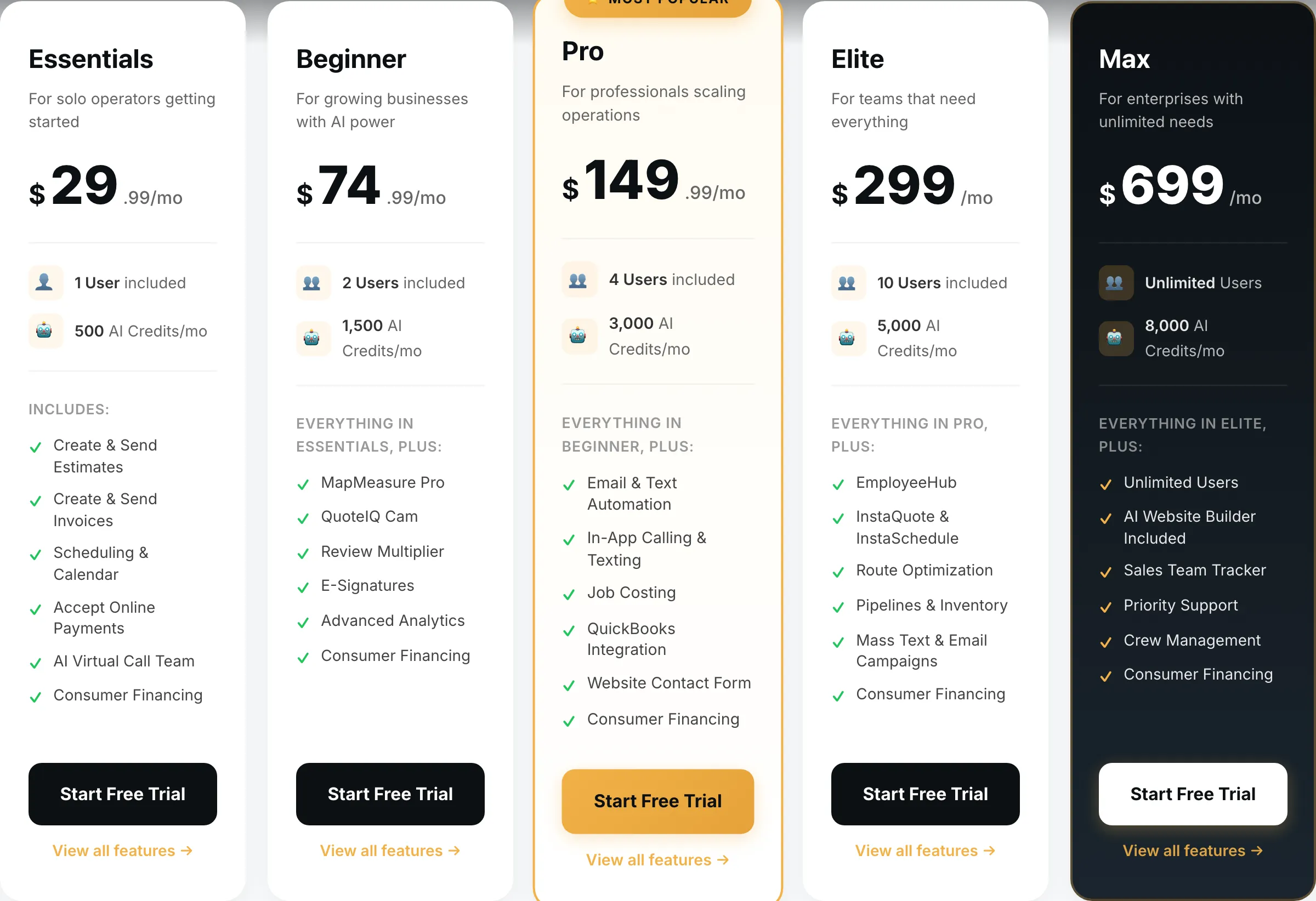
Jobber at $49/mo has the better-looking customer-facing quote and approval flow if that is where you want the money to go, though you measure elsewhere and type the number in. Housecall Pro is the one to look at once you are five people, because five seats are included in its $189/mo plan.
None of them price the job for you. The formula above does that. What they do is stop the quote sitting in your truck for two days, which is where most of the lost work in this trade actually goes.
Questions operators actually ask
How much should I charge for pressure washing per square foot?
Most residential work prices between $0.10 and $0.40 per square foot depending on surface. Flat concrete sits at $0.10 to $0.25, house washing at $0.15 to $0.40, and wood decking higher again at $0.25 to $0.60 because it takes longer and needs lower pressure.
What is a good hourly rate for pressure washing?
$50 to $150 an hour, with most solo operators landing between $75 and $100 once equipment, fuel, chemicals and drive time are covered. Charge hourly only where square footage does not describe the job — commercial cleanups, mixed surfaces, or unknown condition.
What should my job minimum be?
$150 to $250 for residential. Below that, drive time, setup and pack-down eat the job. A $90 driveway forty minutes away is a loss once you count the round trip, and taking it stops you taking a real job that day.
Should I charge more for two-storey houses?
Yes. Height means ladders or extension equipment, slower work and more risk, and it belongs in the price rather than in your evening. Add 25% to 50% over a single-storey rate for the same square footage.
How do I price a job I have not seen?
Give a range and a firm minimum, then confirm on site. Measure off satellite imagery to get within a rough band, but say plainly that the number firms up when you walk it. Quoting a hard price sight-unseen on a neglected property is how operators end up working for free.