The best handyman business software in 2026

The short version
- Best overall for a handyman business
- Jobber — The most finished product, and the quote your customer opens looks like a real company sent it.
- Best cheap option
- QuoteIQ — $29.99/mo does quoting, scheduling, invoicing and payments, which is the whole job for one person.
- Best for one-person crews watching every dollar
- QuoteIQ — Same again — at a third of Jobber's no-commitment monthly price, it is the one that pays for itself first.
Who this is for
You are one to four people doing repairs, installs and small remodels — a morning of drywall, an afternoon hanging doors, a Saturday callout for a leaking tap. You are quoting from the truck, invoicing from the sofa, and chasing at least one customer who has not paid.
You are probably running the business out of a notebook, a spreadsheet, or QuickBooks and a text thread. Everything below is judged on whether it fixes that for a business your size, not on feature count.
If you are ten trucks with an office manager, this is the wrong page.
The comparison
| Tool | Starts at | Users included | Best for | Verdict |
|---|---|---|---|---|
| QuoteIQ | $29.99/mo | 1 | Solo, high quote volume | Cheapest real start; measurement built in |
| Jobber | $49/mo | 1 | One to three people | Best product; $29 per extra seat |
| Housecall Pro | $79/mo | 1 | Five to eight people | Five seats included at $189/mo |
| ServiceTitan | Quote only | Unlimited | Ten trucks and up | Quote-only, annual contract |
Jobber — best overall
$49/mo · One to three peopleThe default field service platform for small home service businesses, and the one most operators compare everything else against.
For a handyman business, Jobber’s strength is the thing the customer sees. The quote arrives as a clean document they can approve on their phone, the reminder goes out on its own, and the payment link works. When you are bidding against a company with a receptionist, that presentation closes jobs you would otherwise lose on perceived size.
The practical catch for handymen specifically is the tier where quote follow-ups live. Handyman work is high-volume, low-value quoting — you might send fifteen quotes to win six jobs — and chasing those by hand is where the day goes. Automated follow-ups are a Connect feature at $139/mo, not a Core feature at $49.
So the real decision is $49 and chase by hand, or $139 and stop. If you send five quotes a week, chase by hand. If you send fifteen, the $90 difference costs less than the jobs you are losing to silence.
What it does well
- The most polished product in the category. Onboarding is fast and the mobile app is the one crews complain about least.
- Client-facing experience — booking page, quote approvals, payment — is a step above everything cheaper.
- Deepest integration list, so it fits whatever you already run the books in.
What it does badly
- The advertised entry price is one user. Seats are $29/mo each on every tier, so a three-person crew on Core is $107/mo, not $49.
- Automation that most operators consider essential — reminders, follow-ups — is Connect and up, a 2.8x jump from Core.
- Prepaid annual pricing is what the marketing quotes; the no-commitment monthly number is meaningfully higher.
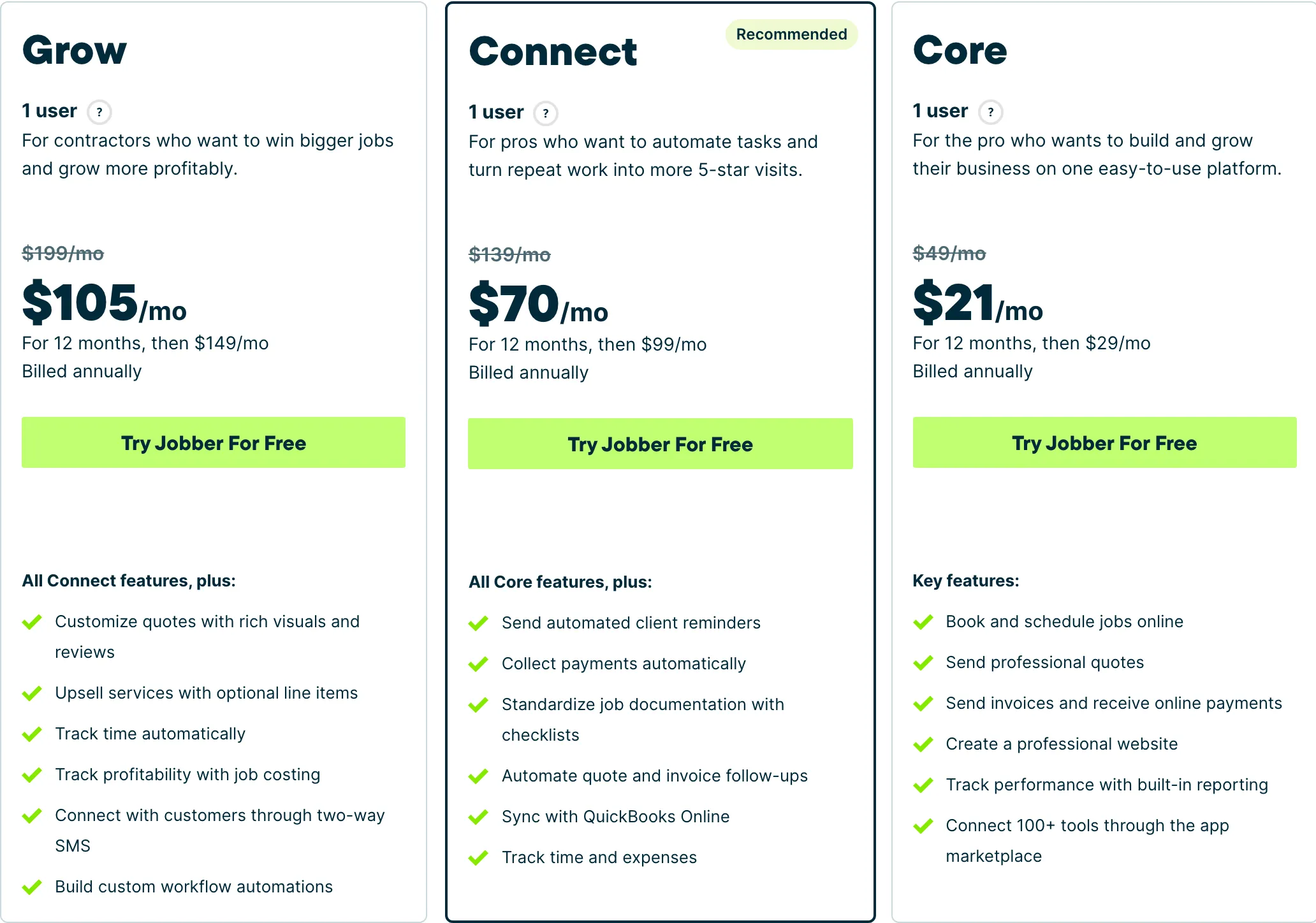
Who it fits: One person to a mid-size crew. The Core tier is genuinely usable solo; the useful automation starts at Connect.
QuoteIQ — best cheap option
$29.99/mo · Solo handymenField service software built for exterior cleaning and outdoor home service crews, with property measurement baked into the quote.
$29.99/mo is the number that matters here. It is roughly one billable hour, and it buys quoting, scheduling, invoicing, online payments and consumer financing for one user.
For handyman work the standout is quote speed. You are pricing small jobs quickly and often, and a saved line-item library plus a phone that sends the quote before you leave the driveway is worth more than any dashboard. MapMeasure Pro is aimed at exterior trades and will matter less to you than to a pressure washer, but it is there if you do fencing or decking.
The trade-offs are real. Fewer integrations than Jobber, a smaller company, and seat counts that tighten quickly — a four-person crew is on the $149.99 Pro tier. And the product is built around exterior and outdoor trades, so some of the vocabulary will feel slightly off for interior repair work.
At the price, none of that outweighs having a working quote-to-cash loop for under $30 a month.
What it does well
- Cheapest real entry point of anything in this category — $29.99 gets a working quote-to-invoice loop, not a crippled trial tier.
- MapMeasure Pro measures a property off satellite imagery, which is the actual job on a lawn, driveway or roof quote.
- Every tier includes the features. No add-on menu bolted on at checkout.
What it does badly
- Smaller company than the incumbents. Fewer integrations, and you will occasionally be the person filing the bug.
- Built around exterior and outdoor trades. If you run commercial mechanical, this is the wrong shape.
- Seat counts are tight below Elite — a four-person crew is already on the $149.99 tier.
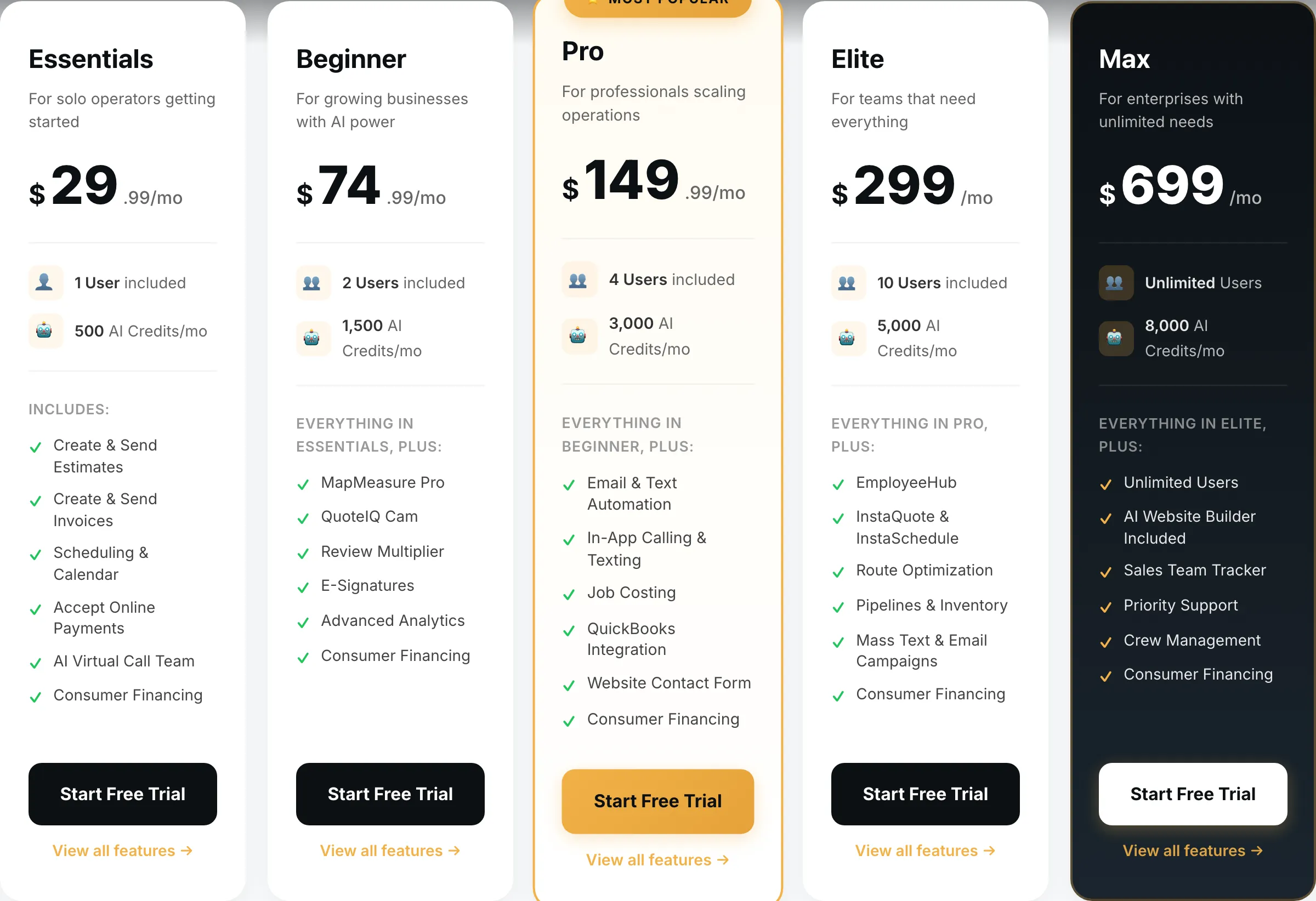
Who it fits: Solo operator to a four-person crew, mostly exterior cleaning and outdoor work.
Housecall Pro — best once you have a crew
$79/mo · Five to eight peopleJobber’s closest competitor, priced for teams rather than solos, with stronger dispatch and marketing tooling.
Skip this if you are on your own. $79/mo for a single user is the worst entry price of the four, and it does not buy more than Jobber Core at $49.
It becomes the right answer at five people, where Essentials includes five seats at $189/mo — a number Jobber cannot match, since the equivalent Grow plan with five seats is $315. If your handyman business has grown into a small crew running a full day of scheduled appointments, the dispatch board and routing are also better than Jobber’s at the matching tier.
Two warnings. Extra users past the fifth are $100/mo each, the highest seat charge here, so a six-person crew should look straight at the $329 Max plan instead. And add-on pricing is not published — you get those numbers on a sales call, so ask before signing anything annual.
What it does well
- Five seats included on Essentials is the best seat-per-dollar deal of the three once you are past two people.
- Dispatch and routing are stronger than Jobber’s at the equivalent tier.
- Recurring service plans on Max are genuinely good if you sell maintenance contracts.
What it does badly
- Worst entry price in the category: $79/mo for a single user, 60% more than Jobber Core for less.
- Extra seats on Essentials are $100/mo — the most expensive seat of any tool here.
- Add-on pricing is not published. You will get those numbers on a sales call, not off the website.
Who it fits: Two to eight people. The seat maths only starts working in your favour once you have a crew.
ServiceTitan — not for you
Quote only · Ten trucks and upEnterprise field service management for multi-truck operations, sold through a sales process rather than a pricing page.
Included because leaving the market leader off a roundup would make this page an advertisement, and because you will see it recommended elsewhere.
For a one to four person handyman business it is the wrong product at any price. No published pricing, an annual contract, a paid implementation, and a feature set built for an operation where somebody’s full-time job is dispatch. You would use perhaps a tenth of it and pay for all of it.
It is genuinely excellent at what it does. What it does is run a fifteen-truck company.
What it does well
- Nothing else touches it for a large operation: reporting, payroll, inventory, call tracking, financing at the door.
- Built for a business where somebody’s full-time job is dispatch.
What it does badly
- No published pricing, an annual contract and an implementation fee. This is not a tool a solo operator buys.
- For a one to four person crew it is the wrong product at any price — you would use perhaps a tenth of it.
Who it fits: Ten trucks and up, with an office manager whose job includes running the software.
How we picked
We read each vendor’s own pricing page on 31 August 2026 and used the no-commitment monthly price, not the prepaid-annual number the marketing quotes. Where seats cost extra we worked out the real cost for a three-person crew, since that is the bill that actually lands.
We weighted, in order: whether the quote-to-cash loop works on a phone from a customer’s driveway; whether the features a handyman needs first — fast quoting, automated follow-ups, same-day invoicing, card payments — sit in a tier a one-to-four person business can afford; and whether the total bill can be calculated without a sales call.
We did not score on feature count. Every tool here has more features than a four-person handyman business will use, and a longer list is not evidence of a better fit — it is usually evidence the product was built for somebody bigger than you.
We have no affiliate relationship with Jobber or ServiceTitan. Jobber is still the best overall pick on this page. That is the test of whether a roundup is worth reading.
What we would do
Solo, under five quotes a week: QuoteIQ Essentials at $29.99, or honestly a spreadsheet for another few months.
Solo to three people, quoting constantly: Jobber — Core at $49 if you will chase quotes yourself, Connect at $139 if you will not.
Five or more: Housecall Pro Essentials at $189 for five seats.
All three have a real 14-day trial without a card. Run one against live jobs for two weeks before you pay for anything — a fortnight of your own quotes tells you more than this page can.
Questions operators actually ask
What software do most handyman businesses use?
Jobber and Housecall Pro have the largest share among small home service businesses generally. Among solo handymen specifically, a great many use nothing but a notebook and a bank app, which is exactly why the cheapest tiers matter more here than feature depth.
What is the cheapest handyman software that actually works?
QuoteIQ at $29.99/mo for one user, which covers quoting, scheduling, invoicing and card payments. Jobber Core at $49/mo is the next step up and is the better-built product. Anything advertised as free is either a trial or an invoicing app with no scheduling.
Do I need field service software as a solo handyman?
Not for the work. You need it for the money — chasing quotes you already sent, invoicing the same day rather than on Sunday night, and taking a card at the door. If you are sending fewer than about five quotes a month, a spreadsheet is honestly fine.
Can this software handle multiple trades on one job?
Yes. All four here support multi-line quotes and invoices, so a job that is two hours of carpentry plus a fixture and a disposal fee prices as one document. This matters more for handymen than for single-trade operators.
How long does it take to set up?
An afternoon for the basics — business details, a payment processor, a handful of saved line items. Building out a full price book takes longer, and most operators do it gradually over the first month rather than up front.