The best landscaping CRM in 2026, judged on route density

The short version
- Best overall for a small landscape crew
- Jobber — Handles recurring maintenance and one-off installs in one system without either feeling like an afterthought.
- Best cheap option
- QuoteIQ — $29.99/mo, and it measures the property off satellite imagery so the quote goes out from the driveway.
- Best for one-person crews
- QuoteIQ — Same pick. Solo landscaping is a quoting-speed business, and this is the fastest cheap way to send one.
Who this is for
You run a landscaping business with one to four people. Some weeks are maintenance rounds — mow, edge, blow, next property — and some are installs: a patio, a planting scheme, a retaining wall. You are quoting off square footage or a walk-around, scheduling around weather, and invoicing monthly for the maintenance and per-job for the rest.
The thing that decides which software fits is not the feature list. It is route density: how many stops you fit in a day, and whether the tool helps or just records what you already decided.
If you run twelve crews, this is the wrong page.
A note on what this is called
People search for this as landscaping CRM, landscaping software and landscaping business software, and in practice they all mean the same thing: one system holding the client list, the schedule, the quotes and the invoicing.
There is no meaningful product difference behind the three names. A true CRM — pipelines, lead scoring, email sequences — is a sales tool, and a four-person landscape crew does not run a sales funnel. Everything below is judged as operations software, whatever it calls itself.
The comparison
| Tool | Starts at | Users included | Best for | Verdict |
|---|---|---|---|---|
| Jobber | $49/mo | 1 | One to four people | Best mix of recurring and one-off work |
| QuoteIQ | $29.99/mo | 1 | Solo and two-person crews | Cheapest; measures the property for you |
| Housecall Pro | $79/mo | 1 | Five to eight people | Best recurring plans, five seats included |
| ServiceTitan | Quote only | Unlimited | Large multi-crew operations | Quote-only, annual contract |
Jobber — best overall for landscaping
$49/mo · One to four peopleThe default field service platform for small home service businesses, and the one most operators compare everything else against.
Landscaping is two businesses in one calendar, and Jobber is the tool that handles both without making either feel secondary. Recurring maintenance visits schedule as a repeating job with their own line items; a patio install schedules as a multi-day job with materials and a deposit. Both invoice from the same client record.
For a maintenance round, the practical win is the client communication. Automated “we’re coming tomorrow” messages cut the calls, and quote follow-ups chase the install work you bid in March and heard nothing about.
The caveat is the same one that applies to every trade: those automations are Connect at $139/mo, not Core at $49. For a maintenance-heavy landscaper that upgrade usually pays, because the reminders reduce the single most expensive thing in the business — turning up to a property you cannot access.
Seats are $29 each, so a three-person crew on Core is $107 and on Connect is $197.
What it does well
- The most polished product in the category. Onboarding is fast and the mobile app is the one crews complain about least.
- Client-facing experience — booking page, quote approvals, payment — is a step above everything cheaper.
- Deepest integration list, so it fits whatever you already run the books in.
What it does badly
- The advertised entry price is one user. Seats are $29/mo each on every tier, so a three-person crew on Core is $107/mo, not $49.
- Automation that most operators consider essential — reminders, follow-ups — is Connect and up, a 2.8x jump from Core.
- Prepaid annual pricing is what the marketing quotes; the no-commitment monthly number is meaningfully higher.
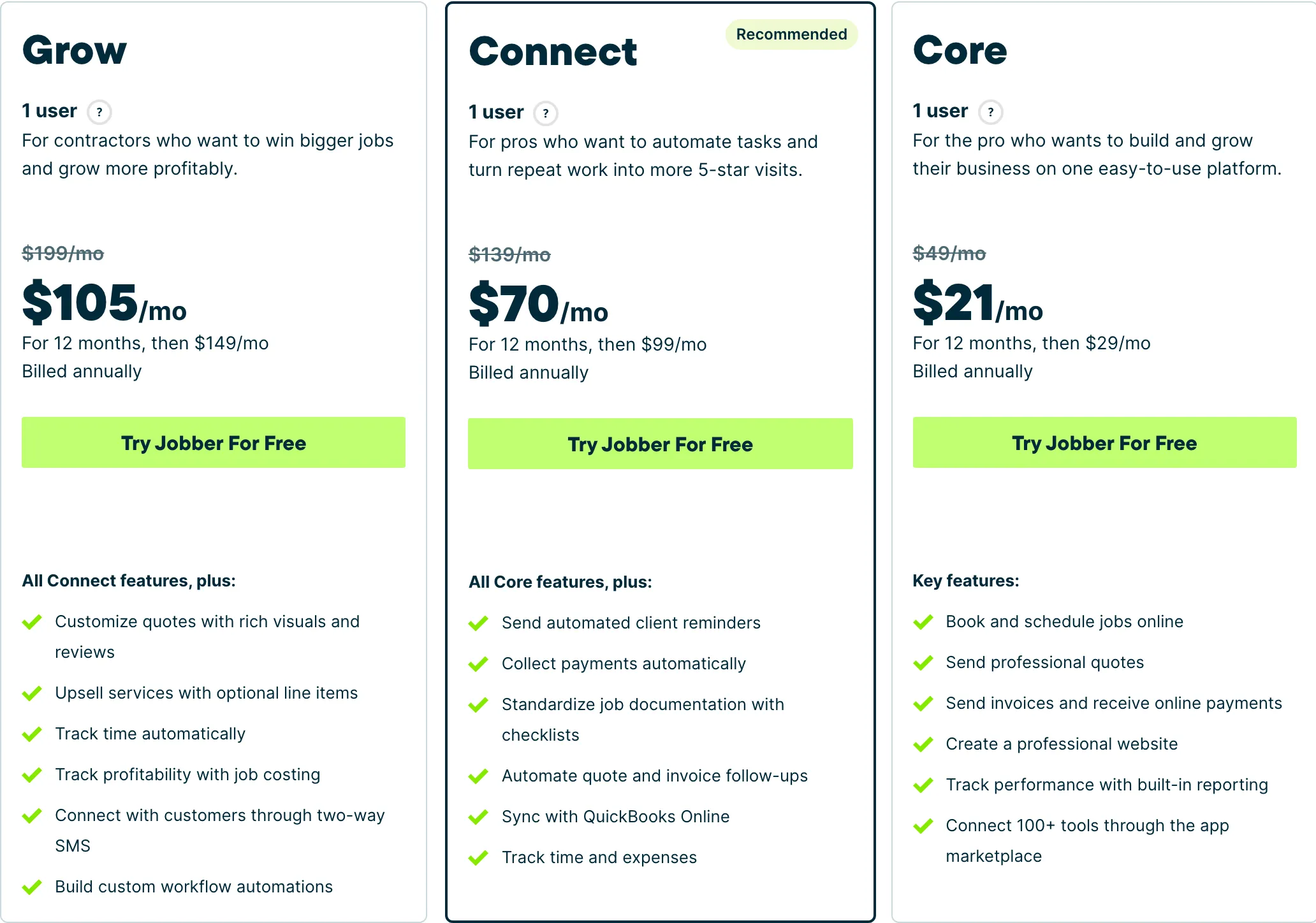
Who it fits: One person to a mid-size crew. The Core tier is genuinely usable solo; the useful automation starts at Connect.
QuoteIQ — best cheap option
$29.99/mo · Solo and two-person crewsField service software built for exterior cleaning and outdoor home service crews, with property measurement baked into the quote.
The feature that earns this a place on a landscaping page specifically is MapMeasure Pro. You trace a lawn, a bed or a driveway on satellite imagery and it gives you the square footage, which drops straight into the quote.
That is the actual job. Landscaping quotes are square-footage quotes, and the alternative is a measuring wheel, a notebook and an evening. Neither Jobber nor Housecall Pro measures a property natively — you measure elsewhere and type the number in.
At $29.99/mo for one user it is the cheapest working option here, and Pro at $149.99 includes four users, which is the same money as Jobber Core with four seats but with job costing and automation included.
The trade-offs: fewer integrations, a smaller company, and no true route optimisation. If your business is a dense weekly mowing round rather than a quoting business, that last one may outweigh the price.
What it does well
- Cheapest real entry point of anything in this category — $29.99 gets a working quote-to-invoice loop, not a crippled trial tier.
- MapMeasure Pro measures a property off satellite imagery, which is the actual job on a lawn, driveway or roof quote.
- Every tier includes the features. No add-on menu bolted on at checkout.
What it does badly
- Smaller company than the incumbents. Fewer integrations, and you will occasionally be the person filing the bug.
- Built around exterior and outdoor trades. If you run commercial mechanical, this is the wrong shape.
- Seat counts are tight below Elite — a four-person crew is already on the $149.99 tier.
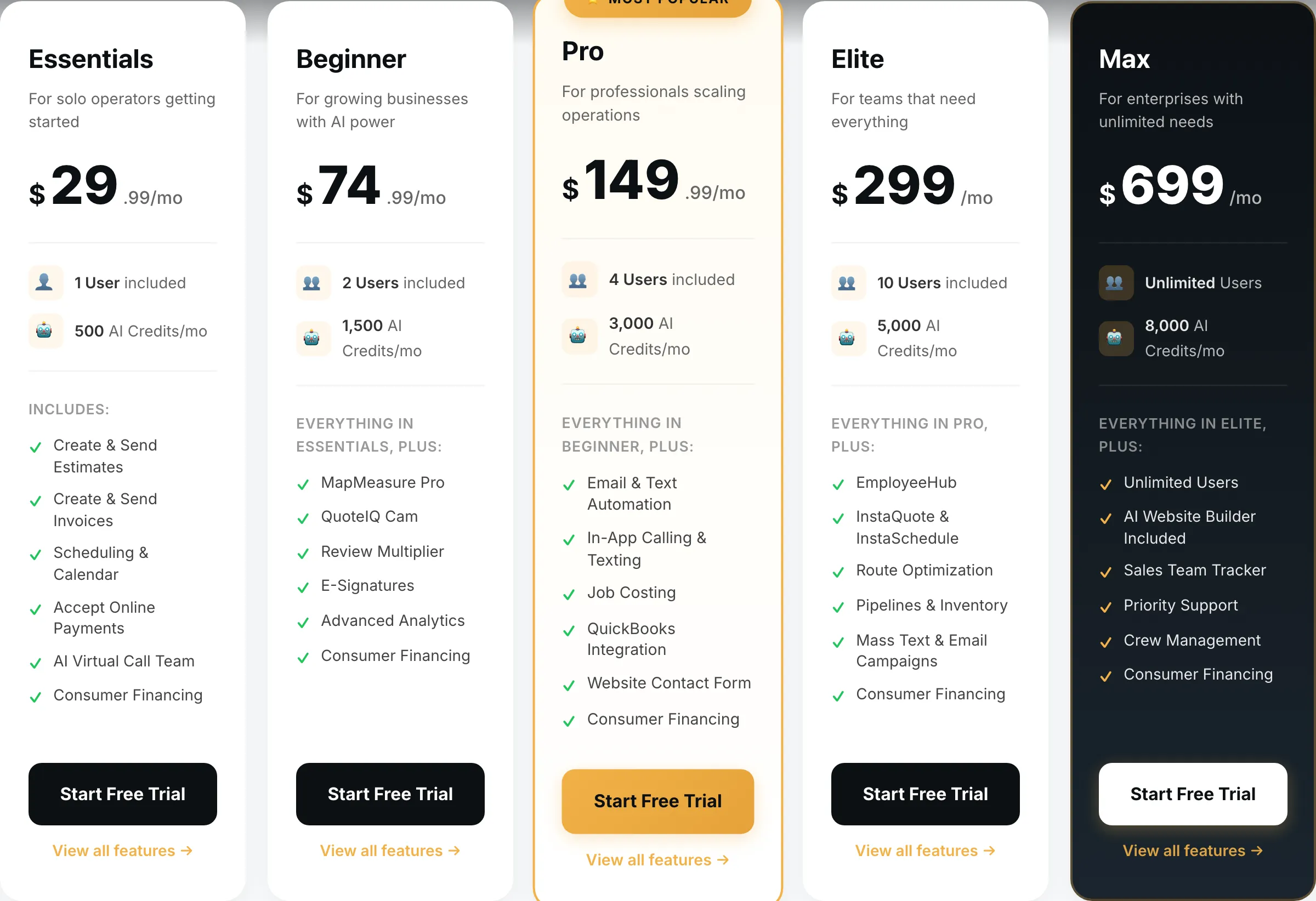
Who it fits: Solo operator to a four-person crew, mostly exterior cleaning and outdoor work.
Housecall Pro — best for maintenance contracts
$79/mo · Five to eight peopleJobber’s closest competitor, priced for teams rather than solos, with stronger dispatch and marketing tooling.
If your revenue is mostly recurring maintenance and you have grown past four people, this is the strongest pick on the page.
Recurring service plans are better built here than anywhere else in the category. A weekly mow, a monthly bed maintenance and a quarterly hedge trim can live as managed plans against one property rather than as three schedules you maintain by hand. Route optimisation on the Max plan is genuine, and on a dense round it converts directly into more stops a day.
Five seats included at $189/mo is the other reason crews land here. Jobber’s equivalent with five seats is $315.
Skip it if you are solo — $79/mo for one user buys less than Jobber Core at $49. And watch the sixth seat at $100/mo; at six people the $329 Max plan with eight seats is the better buy.
What it does well
- Five seats included on Essentials is the best seat-per-dollar deal of the three once you are past two people.
- Dispatch and routing are stronger than Jobber’s at the equivalent tier.
- Recurring service plans on Max are genuinely good if you sell maintenance contracts.
What it does badly
- Worst entry price in the category: $79/mo for a single user, 60% more than Jobber Core for less.
- Extra seats on Essentials are $100/mo — the most expensive seat of any tool here.
- Add-on pricing is not published. You will get those numbers on a sales call, not off the website.
Who it fits: Two to eight people. The seat maths only starts working in your favour once you have a crew.
ServiceTitan — the wrong size
Quote only · Large multi-crew operationsEnterprise field service management for multi-truck operations, sold through a sales process rather than a pricing page.
Named here because a roundup that omits the market leader is an advertisement, and because you will see it recommended.
It is built for a company where dispatch is somebody’s full-time job. No published pricing, an annual contract and a paid implementation. For a one to four person landscaping business it is the wrong product at any price, and the sales process alone will cost you more hours than the software saves in its first year.
What it does well
- Nothing else touches it for a large operation: reporting, payroll, inventory, call tracking, financing at the door.
- Built for a business where somebody’s full-time job is dispatch.
What it does badly
- No published pricing, an annual contract and an implementation fee. This is not a tool a solo operator buys.
- For a one to four person crew it is the wrong product at any price — you would use perhaps a tenth of it.
Who it fits: Ten trucks and up, with an office manager whose job includes running the software.
How we picked
We read every vendor’s pricing page on 31 August 2026 and used the no-commitment monthly price with seats added, because that is the bill that lands rather than the number in the marketing.
For landscaping specifically we weighted recurring-schedule handling, whether quoting from square footage is fast, and route behaviour — the three things that decide whether a maintenance round makes money. We deliberately did not weight CRM features like deal pipelines and email sequences, because a four-person landscape crew does not run a sales funnel; it runs a calendar.
We earn nothing from Jobber or ServiceTitan. Jobber is still the best overall pick here.
What we would do
Solo or two people, install-heavy: QuoteIQ at $29.99 — the measurement tool pays for the subscription in saved evenings alone.
One to four people, mixed maintenance and installs: Jobber, Connect tier if maintenance is most of the revenue.
Five or more, maintenance contracts: Housecall Pro Essentials, or Max if you want route optimisation.
Every one of these has a real 14-day trial with no card. Run it against a live week of your own round — that is the only test that settles it.
Questions operators actually ask
What is the best CRM for a landscaping business?
For one to four people, Jobber — it handles recurring maintenance schedules and one-off installs in the same system without either feeling bolted on. At five or more, Housecall Pro Essentials includes five seats for $189/mo and manages recurring service plans better.
How much does landscaping CRM software cost?
Between $29.99 and $199 a month for a small crew. QuoteIQ starts at $29.99 for one user, Jobber Core at $49, Housecall Pro Basic at $79. The real number depends on seats: Jobber charges $29 per extra user, Housecall Pro $100 past the fifth.
Do I need a CRM if I only do maintenance?
Pure maintenance is where scheduling software pays for itself fastest, because the whole business is a repeating calendar and a route. If you run forty weekly properties off a paper list, you are almost certainly losing a stop or two a month, and each one is a whole season of revenue from that client.
Can these handle seasonal work like snow removal?
Yes. All four support seasonal schedules and separate service types, so a summer mowing round and a winter snow route live in the same client list. Set them up as distinct recurring jobs rather than trying to reuse one schedule.
What about route optimisation?
Housecall Pro Max includes true route optimisation. Jobber orders a day's jobs but does not optimise them the same way. For a dense maintenance round, that difference is worth real money in fuel and stops per day — check it against your own route before assuming it matters.