The best septic business software in 2026

The short version
- Best overall for a septic operation
- Jobber — Multi-year recurring cycles, cheap seats, and a quote the customer approves on their phone.
- Best cheap option
- QuoteIQ — $29.99/mo and fast kerbside quoting, which is most of what a solo pumper needs.
- Best with several trucks
- Housecall Pro — Five seats at $189/mo, stronger routing, and proper service plan management.
Who this is for
You pump tanks. One to three trucks, a customer base of a few hundred properties on a three-to-five year rotation, plus emergencies, inspections for property sales, and the occasional repair or drain field job that pays for the month.
Septic is a long-cycle recurring business, and that is unusual. Lawn care repeats weekly and you remember every client. Septic repeats every three years, and by then the customer has forgotten your name and you have forgotten theirs. The single highest-value thing software does here is make that rotation book itself.
The second thing is disposal. Your margin lives between what you charge and what the treatment plant charges, and that gap moves.
The comparison
| Tool | Starts at | Users included | Best for | Verdict |
|---|---|---|---|---|
| Jobber | $49/mo | 1 | One to four people | Multi-year recurring cycles, cheap seats |
| QuoteIQ | $29.99/mo | 1 | Solo pumpers | Cheapest; fast quoting |
| Housecall Pro | $79/mo | 1 | Five or more people | Service plans + routing, five seats |
| ServiceTitan | Quote only | Unlimited | Large operations | Quote-only, enterprise |
Jobber — best for a septic operation
$49/mo · One to four peopleThe default field service platform for small home service businesses, and the one most operators compare everything else against.
The feature that earns this the pick is unglamorous: a recurring job that repeats every 36 months, and turns up on your schedule on its own.
Set that against your customer base and the business changes shape. Instead of waiting for a call from someone whose tank is backing up, you have a predictable book of scheduled pumps you can route efficiently, plus the emergencies on top. Most septic operators are sitting on several hundred customers they have simply lost track of, and this is the fix.
Beyond that: quotes approve on a phone, invoices carry a card link, and disposal goes on as its own line item so you can see it. Photos attach to the job, which matters for tank condition and for the inevitable “it was already cracked” conversation.
Core is $49/mo plus $29 per seat. A two-truck operation with three people is $107/mo, which for a business turning over what a septic operation turns over is not a real decision.
What it does well
- The most polished product in the category. Onboarding is fast and the mobile app is the one crews complain about least.
- Client-facing experience — booking page, quote approvals, payment — is a step above everything cheaper.
- Deepest integration list, so it fits whatever you already run the books in.
What it does badly
- The advertised entry price is one user. Seats are $29/mo each on every tier, so a three-person crew on Core is $107/mo, not $49.
- Automation that most operators consider essential — reminders, follow-ups — is Connect and up, a 2.8x jump from Core.
- Prepaid annual pricing is what the marketing quotes; the no-commitment monthly number is meaningfully higher.
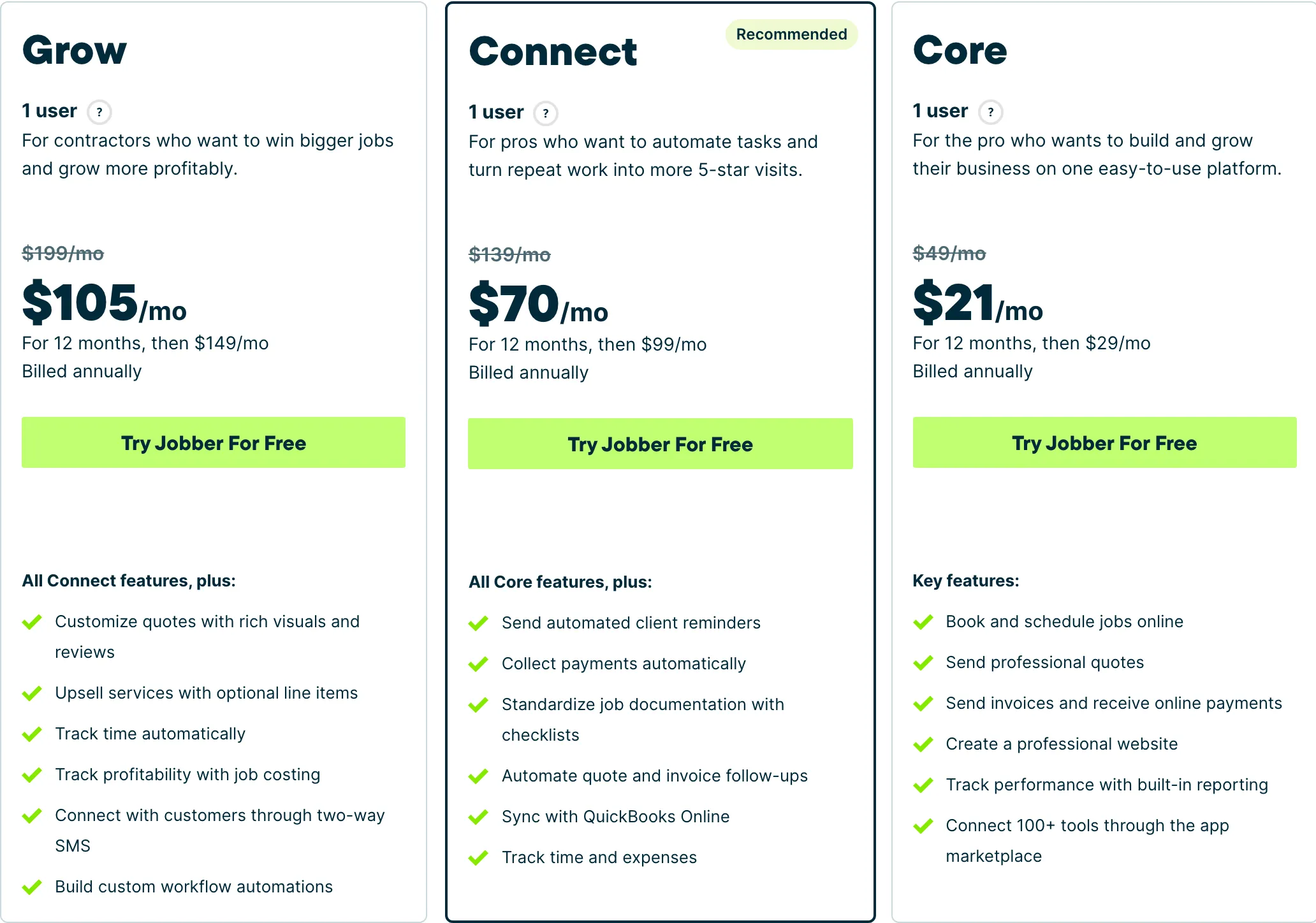
Who it fits: One person to a mid-size crew. The Core tier is genuinely usable solo; the useful automation starts at Connect.
QuoteIQ — best cheap option
$29.99/mo · Solo pumpersField service software built for exterior cleaning and outdoor home service crews, with property measurement baked into the quote.
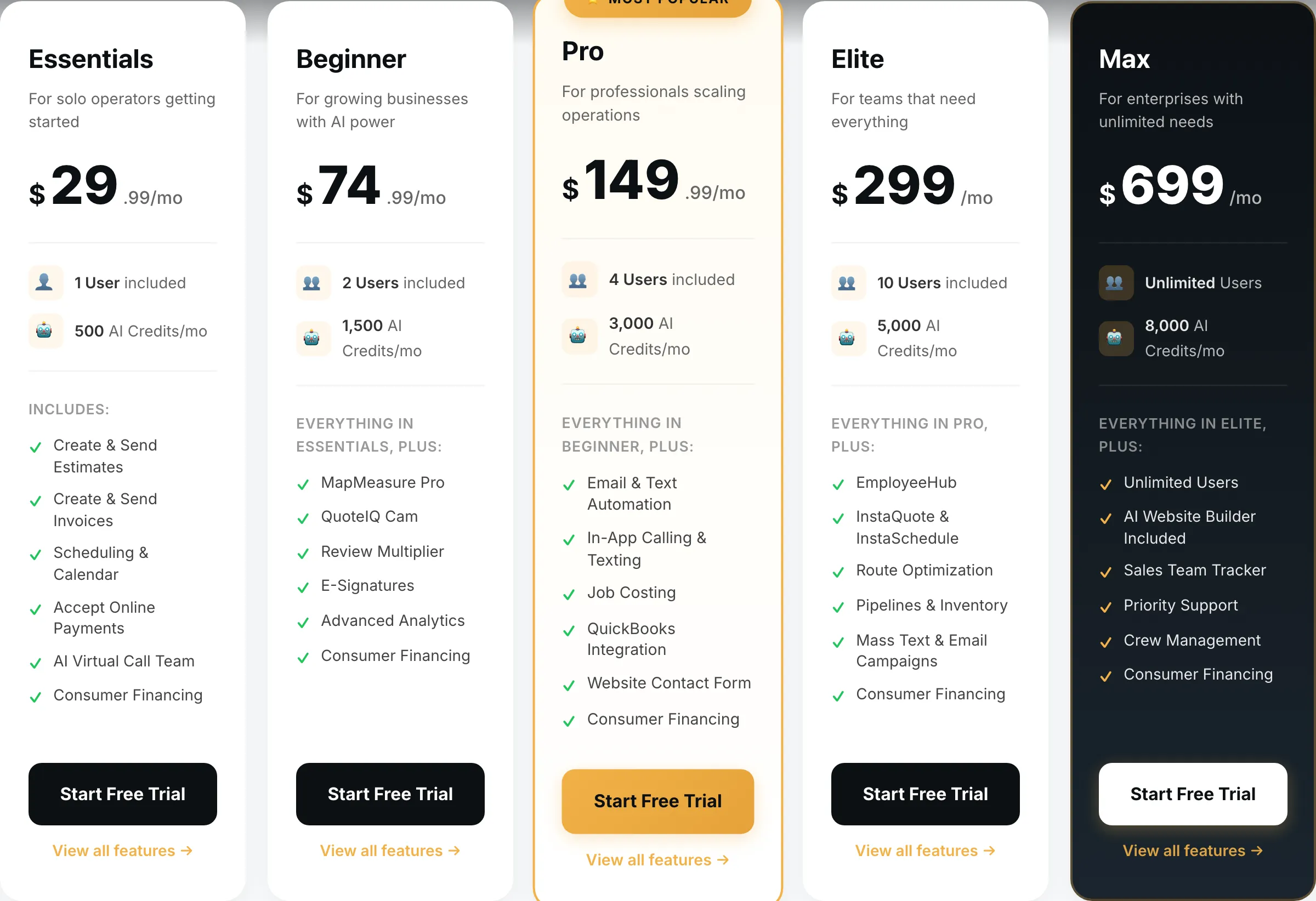
$29.99/mo, and for a one-truck operation it covers the whole money loop: quote, schedule, invoice, take a card before you leave.
Getting paid at the property is worth flagging for septic specifically. Emergency pump-outs are exactly the job where a homeowner is relieved, cash-shy and inclined to say “send me a bill” — and those are the invoices that age. Taking payment at the truck removes that.
Recurring scheduling is thinner than Jobber’s, which matters more here than in most trades given the whole business runs on a multi-year cycle. Check during the trial that you can set a genuinely long repeat interval before committing.
MapMeasure Pro does nothing for you. Ignore that part of the pitch.
What it does well
- Cheapest real entry point of anything in this category — $29.99 gets a working quote-to-invoice loop, not a crippled trial tier.
- MapMeasure Pro measures a property off satellite imagery, which is the actual job on a lawn, driveway or roof quote.
- Every tier includes the features. No add-on menu bolted on at checkout.
What it does badly
- Smaller company than the incumbents. Fewer integrations, and you will occasionally be the person filing the bug.
- Built around exterior and outdoor trades. If you run commercial mechanical, this is the wrong shape.
- Seat counts are tight below Elite — a four-person crew is already on the $149.99 tier.
Who it fits: Solo operator to a four-person crew, mostly exterior cleaning and outdoor work.
Housecall Pro — best with several trucks
$79/mo · Five or more peopleJobber’s closest competitor, priced for teams rather than solos, with stronger dispatch and marketing tooling.
Once you run three trucks and five or more people, the seat maths flips. Essentials includes five seats at $189/mo where Jobber would be $165 and climbing.
Recurring service plans are managed properly here, which suits a septic operation selling a maintenance arrangement rather than one-off pumps. Route optimisation on Max at $329 helps if your pumps cluster geographically — and in rural septic work they usually do, because whole subdivisions went in the same year and come due the same year.
Ignore Basic at $79 for one user.
What it does well
- Five seats included on Essentials is the best seat-per-dollar deal of the three once you are past two people.
- Dispatch and routing are stronger than Jobber’s at the equivalent tier.
- Recurring service plans on Max are genuinely good if you sell maintenance contracts.
What it does badly
- Worst entry price in the category: $79/mo for a single user, 60% more than Jobber Core for less.
- Extra seats on Essentials are $100/mo — the most expensive seat of any tool here.
- Add-on pricing is not published. You will get those numbers on a sales call, not off the website.
Who it fits: Two to eight people. The seat maths only starts working in your favour once you have a crew.
ServiceTitan — the wrong size
Quote only · Large operationsEnterprise field service management for multi-truck operations, sold through a sales process rather than a pricing page.
Named because omitting the market leader would make this an advertisement.
Quote-only pricing, an annual contract, a paid implementation, and a product built for high-volume residential service with a full-time dispatcher. A three-truck septic operation would use a fraction of it.
What it does well
- Nothing else touches it for a large operation: reporting, payroll, inventory, call tracking, financing at the door.
- Built for a business where somebody’s full-time job is dispatch.
What it does badly
- No published pricing, an annual contract and an implementation fee. This is not a tool a solo operator buys.
- For a one to four person crew it is the wrong product at any price — you would use perhaps a tenth of it.
Who it fits: Ten trucks and up, with an office manager whose job includes running the software.
The two things no general tool does
Be clear-eyed about these before you buy:
Manifest and disposal reconciliation. You can attach a ticket and add a line item. You cannot reconcile your treatment plant account against your invoices inside any of these. Do it in a spreadsheet monthly — it is where the margin goes.
County inspection forms. No general field service tool produces county-specific septic inspection paperwork or submits it electronically. If your county requires that, you will be filing separately regardless of what you buy.
Septic-specific platforms exist for larger haulers. We have not verified their pricing, so there are no numbers for them here — every figure on this site is read off the vendor’s own page and dated, and we will not guess at one.
How we picked
Prices read off each vendor’s pricing page on 31 August 2026, no-commitment monthly rate, seats added.
For septic we weighted long-interval recurring scheduling above everything else, because a three-year rotation that books itself is the difference between a predictable business and a reactive one. Then disposal as a visible line item, then seat cost.
We earn nothing from Jobber or ServiceTitan, and Jobber is the pick.
What we would do
One truck: QuoteIQ at $29.99, or Jobber Core at $49 if you want the recurring cycle handled properly — which, for septic, is the whole point.
Two to three trucks: Jobber Core with seats, Connect at $139 once reminders start saving you wasted trips.
Five or more people: Housecall Pro Essentials at $189.
Before you commit, load fifty real customers into the trial and set the pumping interval. If the tool cannot express “every 36 months” cleanly, it is the wrong tool for this trade.
Questions operators actually ask
What software do septic companies use?
Most small pumping operations run a general field service tool — Jobber or Housecall Pro — for scheduling, invoicing and payments, and track disposal and manifests separately. Septic-specific platforms exist but are aimed at larger haulers with multiple trucks and their own treatment arrangements.
Can these handle a three-year pumping cycle?
Yes, and this is the single most valuable thing software does for a septic business. A recurring job set to repeat every 36 months turns a customer you would otherwise forget into a booking that appears on its own. Most septic operators lose more revenue to unbilled forgotten customers than to anything else.
How do I track disposal and dump fees?
As a separate line item per job, with the manifest or ticket attached as a photo. All four support that. What none of them do is reconcile your treatment plant account against what you billed — check that by hand monthly, because disposal is where septic margins quietly disappear.
What about county inspection paperwork?
None of these generate county-specific inspection forms. The workaround is a checklist on the job plus photo attachments, then filing the county form separately. If your county requires electronic submission, ask about it before you buy — no general field service tool does that.
Is it worth paying for software with one truck?
The recurring pumping cycle alone usually justifies it. If you have 300 customers on a three-year rotation, that is roughly 100 pumps a year that should book themselves. Even at a 10% recovery of customers you would otherwise have lost track of, the software pays for itself several times over.