The best HVAC software in 2026, for shops under ten vans

The short version
- Best overall for a small HVAC shop
- Housecall Pro — Maintenance agreements and a real dispatch board, five seats at $189/mo.
- Best value under five people
- Jobber — Core at $49 with $29 seats — nothing else is close at that headcount.
- Best above ten vans
- ServiceTitan — This is its home trade, and past a certain size nothing else competes. Budget for implementation.
Before anything else: two different products
HVAC software and HVAC estimating software are not the same thing, and the gap between them has cost people real money.
What is on this page is field service software. Calls come in, you dispatch a van, a technician services or replaces a unit, you invoice, and you sell a maintenance agreement.
“HVAC estimating software” means commercial takeoff — you load a set of drawings, measure duct and pipe runs off the plan, and produce a bid for a mechanical contract. That SERP belongs to QuoteSoft, PlanSwift, MeasureSquare and STACK, and those tools are sold to commercial mechanical contractors. The advertised click prices there are enormous, which makes the category look attractive from the outside; it is a different industry bidding.
If you price commercial mechanical work off drawings, nothing here is for you.
Who this is for
One to about eight people running residential or light commercial HVAC service. Summer and winter peaks that decide the year, shoulder seasons that decide whether you keep your technicians, and a maintenance agreement base you are either building or wish you had.
The comparison
| Tool | Starts at | Users included | Best for | Verdict |
|---|---|---|---|---|
| Housecall Pro | $79/mo | 1 | Five to eight people | Agreements + dispatch, five seats at $189 |
| Jobber | $49/mo | 1 | One to four people | Best value, cheap seats, thinner agreements |
| ServiceTitan | Quote only | Unlimited | Ten vans and up | Category leader; quote-only |
| QuoteIQ | $29.99/mo | 1 | Solo, tightest budget | Cheapest; built for exterior trades |
Housecall Pro — best for a small HVAC shop
$79/mo · Five to eight peopleJobber’s closest competitor, priced for teams rather than solos, with stronger dispatch and marketing tooling.
This is where most HVAC shops between three and ten people land, and the reason is recurring service plans.
A maintenance agreement is not just a recurring appointment. It is a commercial object: a customer pays monthly or annually, gets two visits and priority scheduling, and the plan renews. Housecall Pro manages that properly — which matters because agreements are what carry an HVAC business through April and October, and they are the single biggest thing a buyer looks at if you ever sell.
The dispatch board is the other reason. In July, HVAC dispatch is triage, and reassigning a day of calls across four vans is a daily job. Housecall Pro’s board handles that better than Jobber’s.
Essentials at $189/mo includes five seats; Max at $329 includes eight and adds route optimisation and the sales proposal tool, which is worth having if you sell replacements.
Two warnings. The sixth seat on Essentials is $100/mo, so at six people go straight to Max. And add-on pricing is not published — get it quoted in writing before signing anything annual.
What it does well
- Five seats included on Essentials is the best seat-per-dollar deal of the three once you are past two people.
- Dispatch and routing are stronger than Jobber’s at the equivalent tier.
- Recurring service plans on Max are genuinely good if you sell maintenance contracts.
What it does badly
- Worst entry price in the category: $79/mo for a single user, 60% more than Jobber Core for less.
- Extra seats on Essentials are $100/mo — the most expensive seat of any tool here.
- Add-on pricing is not published. You will get those numbers on a sales call, not off the website.
Who it fits: Two to eight people. The seat maths only starts working in your favour once you have a crew.
Jobber — best value under five people
$49/mo · One to four peopleThe default field service platform for small home service businesses, and the one most operators compare everything else against.
For a shop of one to four, Jobber is materially cheaper and good enough at the things that size of business actually does.
A three-person shop on Core is $107/mo against Housecall Pro Essentials at $189 — and on Essentials you would be paying for two seats you are not using. Quotes look excellent on the customer’s phone, which matters when you are quoting a $9,000 system replacement against two other companies.
The honest limitations for HVAC specifically: recurring jobs will schedule your maintenance visits, but there is no agreement management behind them — no plan renewal, no plan-holder priority, no revenue view of your agreement base. Equipment records live as notes and attachments rather than as structured assets. And the dispatch board is simpler than you will want in a July heatwave.
If maintenance agreements are the core of your model, that gap is the reason to pay more elsewhere. If you are mostly doing service calls and replacements, Core at $49 is very hard to argue with.
What it does well
- The most polished product in the category. Onboarding is fast and the mobile app is the one crews complain about least.
- Client-facing experience — booking page, quote approvals, payment — is a step above everything cheaper.
- Deepest integration list, so it fits whatever you already run the books in.
What it does badly
- The advertised entry price is one user. Seats are $29/mo each on every tier, so a three-person crew on Core is $107/mo, not $49.
- Automation that most operators consider essential — reminders, follow-ups — is Connect and up, a 2.8x jump from Core.
- Prepaid annual pricing is what the marketing quotes; the no-commitment monthly number is meaningfully higher.
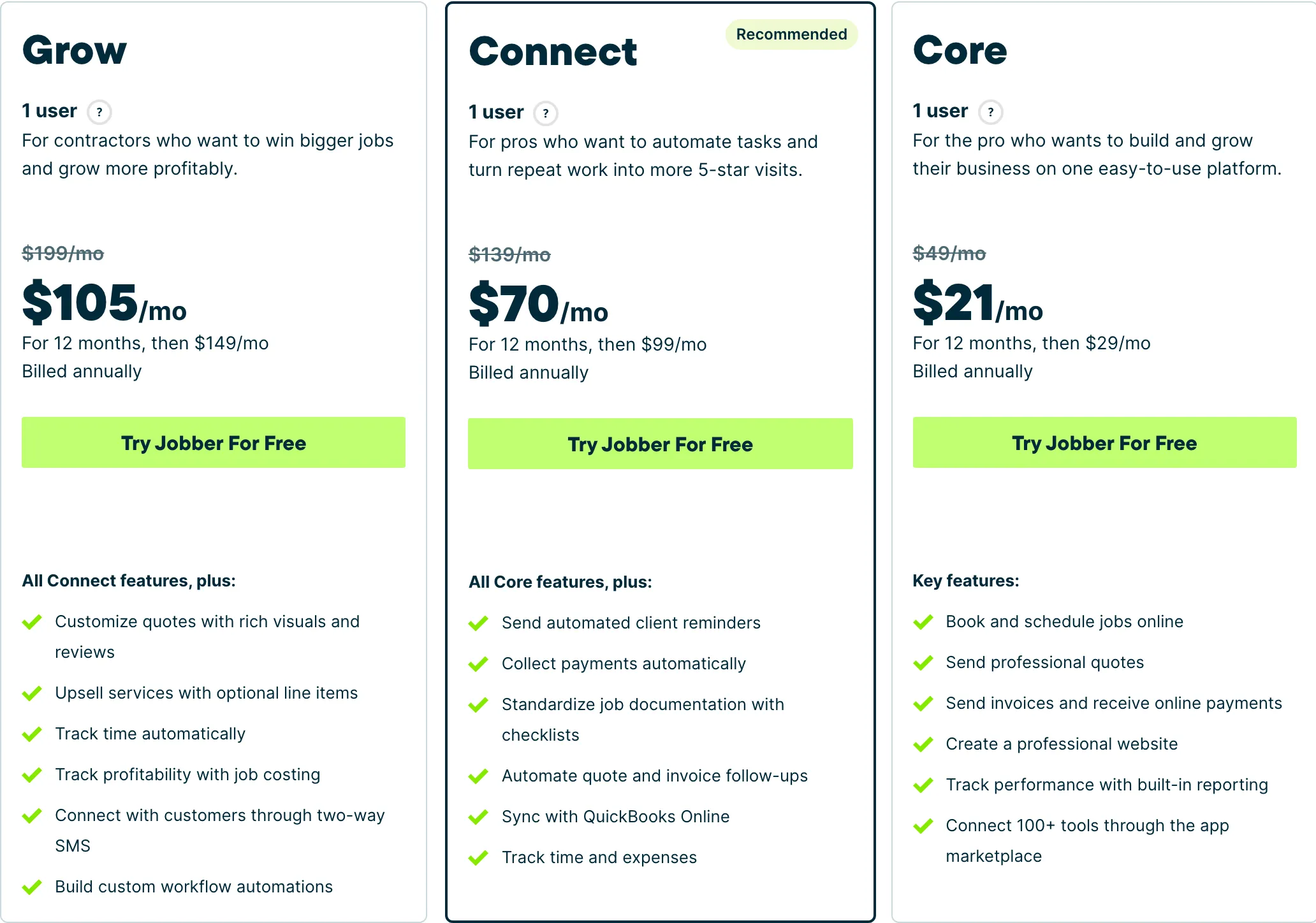
Who it fits: One person to a mid-size crew. The Core tier is genuinely usable solo; the useful automation starts at Connect.
ServiceTitan — the leader, at the right size
Quote only · Ten vans and upEnterprise field service management for multi-truck operations, sold through a sales process rather than a pricing page.
HVAC is ServiceTitan’s home trade, and above roughly ten vans nothing else is in the conversation.
Equipment tracking with install dates and warranty status. Membership programmes with proper renewal management. Call booking with recording, so you can hear why your CSR lost the job. Technician scorecards. Inventory across vans. Financing presented at the kitchen table, which for a $12,000 system replacement closes work that would otherwise walk. Reporting that tells you which technicians and which job types actually make money.
The caveats have not changed: no published pricing, an annual contract, a paid implementation, and an assumption that dispatch is somebody’s full-time role. Below about ten vans you would use a fraction of it and pay for all of it — and the implementation alone will consume more of your time than the software saves in year one.
What it does well
- Nothing else touches it for a large operation: reporting, payroll, inventory, call tracking, financing at the door.
- Built for a business where somebody’s full-time job is dispatch.
What it does badly
- No published pricing, an annual contract and an implementation fee. This is not a tool a solo operator buys.
- For a one to four person crew it is the wrong product at any price — you would use perhaps a tenth of it.
Who it fits: Ten trucks and up, with an office manager whose job includes running the software.
QuoteIQ — cheapest, and the wrong shape
$29.99/mo · Solo operators on the tightest budgetField service software built for exterior cleaning and outdoor home service crews, with property measurement baked into the quote.
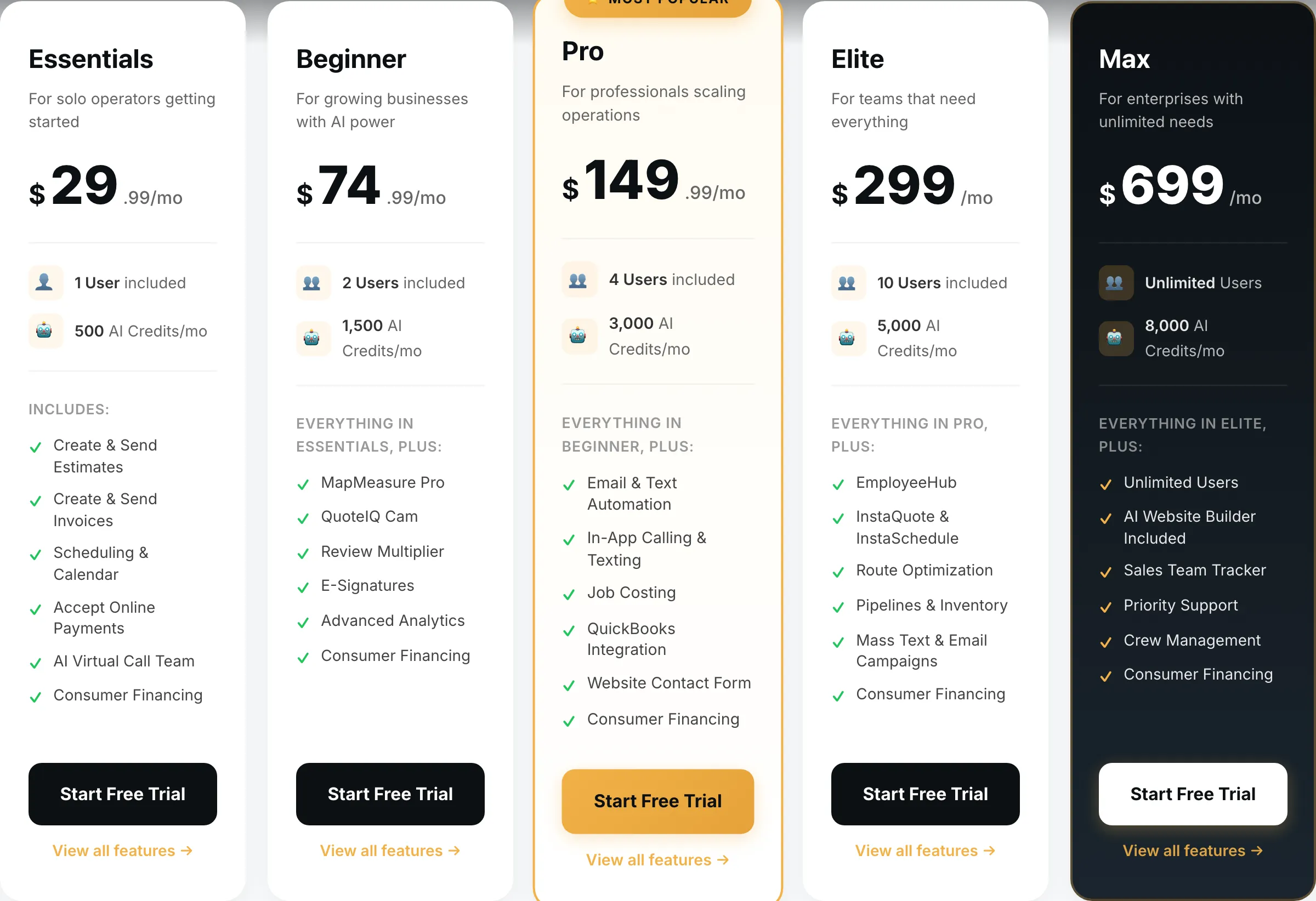
Included because it is the cheapest working option at $29.99/mo, and for a solo operator currently running on a notebook it would be an improvement — estimates, invoices, scheduling, card payments.
But this is the page where we should be most direct about fit. QuoteIQ is built around exterior and outdoor trades. Its headline feature, satellite property measurement, is useless to you. There is no maintenance agreement management, no equipment tracking worth the name, and no dispatch board suited to a summer peak.
For HVAC we would only recommend it to a genuinely solo operator for whom the difference between $29.99 and $49 is the deciding factor. Otherwise Jobber Core at $49 is a better fit for $19 more.
What it does well
- Cheapest real entry point of anything in this category — $29.99 gets a working quote-to-invoice loop, not a crippled trial tier.
- MapMeasure Pro measures a property off satellite imagery, which is the actual job on a lawn, driveway or roof quote.
- Every tier includes the features. No add-on menu bolted on at checkout.
What it does badly
- Smaller company than the incumbents. Fewer integrations, and you will occasionally be the person filing the bug.
- Built around exterior and outdoor trades. If you run commercial mechanical, this is the wrong shape.
- Seat counts are tight below Elite — a four-person crew is already on the $149.99 tier.
Who it fits: Solo operator to a four-person crew, mostly exterior cleaning and outdoor work.
How we picked
Prices read off each vendor’s own pricing page on 31 August 2026, at the no-commitment monthly rate with seats added.
For HVAC we weighted maintenance agreement handling first, because agreements are what make this business survive a mild shoulder season; dispatch under load second, because a July day is triage; and equipment records third.
We deliberately excluded takeoff and estimating tools, which serve commercial mechanical bidding rather than service work — see the section at the top.
We earn nothing from Jobber or ServiceTitan, and both are recommended above the tool that does pay us wherever they fit better. On this page, that is most of the time.
What we would do
Solo: Jobber Core at $49. Only look at QuoteIQ at $29.99 if that $19 genuinely decides it.
Two to four people: Jobber Core with seats at $29 each, moving to Connect at $139 for automated reminders once the volume justifies it.
Five to eight, building an agreement base: Housecall Pro Essentials at $189, or Max at $329 if you sell replacements and want the proposal tool.
Ten vans and a dispatcher: ServiceTitan, with the implementation budgeted as seriously as the licence.
Run the trial in your busy season, not your quiet one. Every tool here handles a calm Tuesday. The one you want is the one that survives a July Friday with two technicians out sick.
Questions operators actually ask
What software do HVAC companies use?
ServiceTitan dominates among larger companies, and Housecall Pro is the common choice for shops of roughly three to ten people. Under about five, Jobber is the value pick. The split is mostly about maintenance agreements and dispatch — the bigger you get, the more those two decide the answer.
Is HVAC software the same as HVAC estimating software?
No, and confusing them is expensive. This page covers field service software: dispatch, work orders, maintenance agreements, invoicing. HVAC estimating software means commercial takeoff — pricing mechanical work off drawings — and that market belongs to QuoteSoft, PlanSwift and STACK. Different product, different buyer, much higher advertised click prices.
Which handles maintenance agreements best?
ServiceTitan first, then Housecall Pro. Recurring service plans are the backbone of a stable HVAC business — they smooth the shoulder seasons and they are the single biggest driver of company value at sale. Jobber can schedule recurring visits but does not manage agreements as commercial objects.
How much does HVAC software cost?
$49 to about $330 a month for a small shop. Jobber Core is $49 plus $29 per seat, Housecall Pro Essentials is $189 for five seats and Max is $329 for eight. ServiceTitan does not publish pricing and sells through a demo with an annual contract.
Do these track equipment and serial numbers?
Partially. All of them let you record equipment against a customer property, but the depth varies a lot. ServiceTitan does it properly, including install dates and warranty status. The others store it as attachments and notes, which works until you want to run a report on every unit approaching end of life.